Serving Simcoe County · Muskoka · Ontario

When the answer everywhere else is no, private lending is often yes.

Some situations do not fit any bank's rulebook. Bruised credit, income you cannot easily prove, tax arrears, a deal that has to close fast, or a property tied up in an estate. Private lenders look mostly at the equity in the property, not the boxes a bank ticks, so they can say yes where others cannot. It is usually a bridge to get you through, not forever, and I will be straight with you about that.

25+
Years helping Ontario homeowners
100+
Lenders, from the big banks to private investors
40+
Five Star Google Reviews

Come talk to me if you are facing

  • A no from the bank and the alternative lenders
  • Credit or income that does not fit the usual rules
  • A closing that has to happen fast
  • Tax arrears or debts you need to clear
  • A property inherited or held in an estate
  • Power of sale or foreclosure pressure

How private lending works

Private lenders look at the property first, not just your paperwork.

A bank starts with your income, your credit, and whether you fit their exact policy. A private lender starts with a different question: how much equity is in the property. If there is enough, they can often lend even when your credit is bruised, your income is hard to document, or the clock is ticking. That is why private lending solves problems that leave the banks stuck.


The tradeoff is honest and worth saying plainly. Private mortgages usually cost more and run for a shorter term, often around a year. The idea is not to stay there forever. It is to solve the immediate problem, give you breathing room, and set up a plan to move back to a regular lender once things are stable. Used that way, it is a genuinely useful tool, and lining up the right private lender for your situation is what I do.

Who this is for

The kind of situations I help with

Turned down everywhere

A house sitting on anything from a couple of acres to a hundred, where the land is a big part of what you are buying.

Credit or income issues

A bit of land, maybe some animals or crops, that is not your full time living. These need lenders who understand the setup.

Need to close fast

No municipal water or sewer. Common in the country, and something certain lenders want documented before they say yes.alongside your lawyer to keep it moving.

Clearing tax or debts

Beautiful to live in, trickier to finance. Non-standard construction narrows the list of lenders, but it does not close the door.

Inherited or estate property

Barns, shops, drive sheds, second garages. Whether that value counts toward your mortgage depends entirely on the lender.

Facing power of sale

If you are behind and at risk of losing the home, a private mortgage can sometimes stop the process and buy time.

What matters most

What a private lender actually weighs

Private lending is more flexible than a bank, but these are the things that decide the deal.

The equity in the property

Many lenders cap the acreage they will value. Anything past that may not add to what you can borrow.

The property itself

Whether the road to the property is maintained all year, and who maintains it, can matter to an approval.

Your exit plan

A barn or shop can be a real asset, but not every lender counts it. That difference can move your numbers.

The size of the request

How much you need against how much equity there is shapes which lenders will do it.

The urgency

If it has to close fast, that narrows the field to lenders who can actually move at that speed.

The estate or title situation

For inherited or estate property, how the title and the estate are structured affects what is possible.

How it works

Straightforward, discreet, and I stay with you the whole way

STEP 1

Tell me the situation

What is going on, what the property is worth, and what you need to happen. No judgment, just the facts.

STEP 2

I find a lender who fits

I go to private lenders who handle your kind of file and arrange terms that solve the immediate problem.

STEP 3

We solve it and plan the exit

We get you through the crunch, then map out how to move back to a regular lender or sell when the time is right.

40+ Verified Five Star Google Reviews

Real situations we've helped with.

Mortgage Broker
#M08006998

CONTACT US APPLY NOW

Download My Mortgage App HERE

Meet Anita

Financing is what I love doing

Hello, I’m Anita. Thanks for visiting me online. My team and I absolutely love arranging mortgage financing for people like you; it’s our passion. If you're looking to purchase or refinance your existing home or investment property, I specialize in providing customized solutions for my clients. You've come to the right place!


My goal is to help facilitate your financial goals and find the perfect funding solution to lower the overall cost of borrowing. I keep up to date on global economics to sight the trends that might affect the industry, so you don't have to. It’s always exciting to discuss strategies in our evolving economic climate. Times are tough, and with mortgage guidelines continually changing, it can be a challenge to obtain financing, even for someone with excellent credit and net worth!


I have been happily married for over 40 years, and we're proud parents of two children and eight beautiful grandchildren! I enjoy spending time with family, I'm an avid foodie, and enjoy travelling.

Areas served

Private lending and estate financing across the region

Home base is Orillia, and I arrange private mortgages and estate financing throughout Simcoe County, Muskoka, and Ontario. Most of the work happens by phone, email, and video, so where you are is rarely a barrier, and I know these situations often need to move quickly.

Orillia Barrie Gravenhurst Bracebridge Midland Coldwater Washago Severn Ramara Oro-Medonte Simcoe County Muskoka Kawartha Lakes Ontario
All of BC & Alberta

Common questions

Private lending and estate questions

  • What is a private mortgage?

    It is a mortgage from a private lender or an investment group rather than a bank. They lend mainly based on the equity in your property, which means they can often say yes when your credit, income, or timing does not fit a bank. They usually cost more and run for a shorter term, so they are meant to solve a problem, not to be forever.

  • Why would I use a private lender instead of a bank?

    Usually because the bank already said no, or cannot move fast enough. Private lenders are more flexible on credit and income and can often close quickly. If a bank will do your deal, that is almost always cheaper, and I will tell you so. Private lending is for when it will not.

  • Are private mortgages expensive?

    They cost more than a bank mortgage, yes, and I will always be upfront about the numbers. The way to think about it is what the private mortgage lets you do: clear a crisis, close a deal, or protect your home, then refinance to something cheaper once you are stable. Used as a short bridge, the cost buys you a solution.

  • How does financing work for an inherited or estate property?

    It comes up often. Sometimes an estate needs funds before the assets can be distributed, or one person wants to keep a property and buy out the others. A private mortgage against the property can provide that money, so the estate can be settled without a forced quick sale. The right setup depends on how the estate and title are arranged.

  • Can I buy out my siblings on an inherited home?

    Often, yes. If you want to keep a family property and others are inheriting a share, financing can free up the money to buy them out fairly. Depending on the situation that might be a regular mortgage or a private one, and I will help you figure out which fits.

  • I am facing power of sale. Can private lending help?

    Sometimes it can. If there is enough equity in the home, a private mortgage can pay out what is owed and stop the process, giving you time to get back on your feet or sell on your own terms rather than in a rush. Reach out early, because with these the timing really matters.

  • How do I get out of a private mortgage later?

    That is the plan from day one. A private mortgage is a bridge, so we set it up with an exit in mind, usually refinancing to a regular lender once your credit, income, or situation has improved, or selling if that is the goal. I stay in touch so we make that move when the time is right.

Everything, in one place

Other situations I handle

Each of these has its own page that walks through the details in plain language.
RESIDENTIAL

Buying, renewing and refinancing

    PROPERTY TYPES

    Rural, farm and recreational

      COMPLEX SOLUTIONS

      Trickier situations

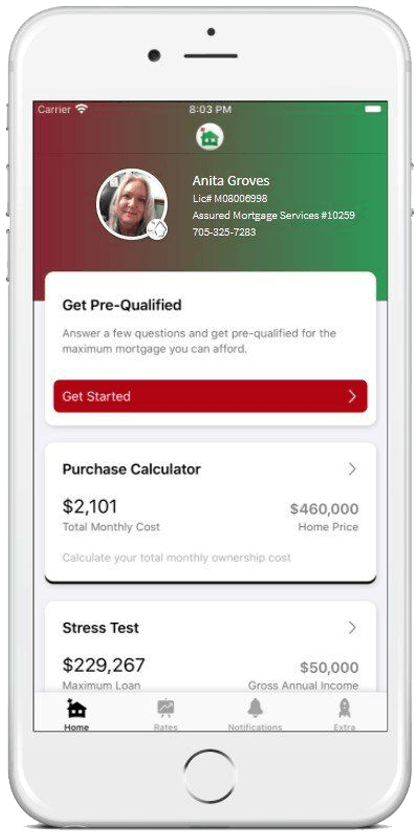
        Download the Canadian Mortgage App and:


        • Calculate your total cost of owning a home
        • Estimate the minimum down payment you need
        • Calculate Land transfer taxes and the available rebates
        • Calculate the maximum loan you can borrow
        • Stress test your mortgage
        • Estimate your Closing costs
        • Compare your options side by side
        • Search for the best mortgage rates
        • Email Summary reports (PDF)
        • Use my app in English, French, Spanish, Hindi and Chinese

        Stuck? Let's find the yes.

        If the banks have run out of answers, that does not mean there are none. A short call now, no judgment and no cost, and you will know what is actually possible.

        Call or text 705·325·7283 · 773 Atherley Road, Orillia, ON

        Articles To keep you informed

        Resources

        By Anita Groves August 26, 2026
        When you’re buying a home, two terms often cause confusion: deposit and down payment . While they’re related, they serve very different purposes in the homebuying process. Here’s what you need to know. What Is a Deposit? A deposit is the money you provide when you make an offer on a property. Think of it as a show of good faith that proves you’re serious about purchasing. How it works : Typically, you provide a certified cheque or bank draft that your real estate brokerage holds in trust. If your offer is accepted, the deposit remains in trust until the deal moves forward. If negotiations fall through, the deposit is refunded. Connection to your down payment : Once the sale is finalized, your deposit becomes part of your total down payment. Why it matters : The amount is negotiable, but a larger deposit can make your offer more attractive in a competitive market. Keep in mind, however, that if you back out after conditions are removed, you risk losing your deposit. What Is a Down Payment? Your down payment is the amount you contribute toward the purchase price of your home when securing a mortgage. Minimum requirement : In Canada, the minimum down payment is 5% of the home’s purchase price. Anything less than 20% requires mortgage default insurance. Sources : Down payments can come from your savings, the sale of another property, RRSP withdrawals (through the Home Buyers’ Plan), a gift from family, or even borrowed funds. Example: How They Work Together Imagine you’re buying a $400,000 home with a 10% down payment ($40,000). When you make your offer, you provide a $10,000 deposit . Once conditions are met, that deposit is transferred to your lawyer’s trust account. At closing, you add the remaining $30,000 to complete your full down payment. The lender provides the rest—$360,000—through your mortgage. The Bottom Line Your deposit shows commitment and secures your offer, while your down payment is what makes the mortgage possible. Together, they work hand in hand to get you into your new home. 📞 If you’d like clarity on deposits, down payments, or any other part of the mortgage process, let’s connect. I’d be happy to walk you through it step by step.
        By Anita Groves August 19, 2026
        Saving for a down payment is one of the biggest challenges first-time buyers face. What many don’t realize is that the Canadian government offers a program designed to make it easier—the Home Buyers’ Plan (HBP) . This program allows you to withdraw money from your RRSP to help purchase your first home, without immediate tax consequences. Here’s how it works: Who Qualifies? To be eligible, you generally need to be a first-time home buyer. In practical terms, this means you must not have owned a home in the past four years, nor lived in a property owned by your spouse or partner during that time. There are also special allowances if you’re living with a disability or helping a relative with a disability. In these cases, you can use the HBP even if you’ve owned a home more recently. How Much Can You Withdraw? Under the program, you can access up to $35,000 from your RRSP as an individual. Couples can combine their withdrawals for a total of $70,000 . These funds must have been in your RRSP for at least 90 days before you take them out. Paying It Back The HBP isn’t “free money”—it’s an interest-free loan from your own retirement savings. You’ll have 15 years to repay the full amount back into your RRSP, starting in the second year after withdrawal. Each year, the CRA will send you an HBP Statement of Account outlining how much needs to be repaid. If you don’t make your repayment in a given year, that amount will be added to your taxable income. Why It’s a Smart Strategy The HBP can give first-time buyers a powerful boost toward homeownership. It helps you put together a larger down payment, which can reduce your mortgage amount and monthly payments. Just remember: it’s important to balance the short-term benefit of homeownership with the long-term impact on your retirement savings. Next Steps Thinking about using the Home Buyers’ Plan? Let’s sit down and review whether it’s the right move for you. Together, we can create a strategy that gets you into your first home while keeping your future financial goals on track. 📞 Reach out anytime—it would be a pleasure to guide you through the process.
        By Anita Groves August 12, 2026
        When it comes to selling your home, most people think the first call should be to a real estate agent. But the smartest first step often isn’t with your agent—it’s with an independent mortgage professional. Why? Because your mortgage plays a bigger role in your bottom line than most people realize. Planning to Buy After You Sell If selling means you’ll also be purchasing another property, you’ll want to know exactly where you stand financially before listing. Mortgage rules change regularly, and qualifying once doesn’t guarantee you’ll qualify again. Getting a pre-approval in place ensures you know what you can afford and eliminates surprises later. On top of that, reviewing the terms of your existing mortgage could uncover options you may not have considered. For example, porting your mortgage instead of arranging a brand-new one could save you thousands. Selling Without Buying Even if you aren’t planning to buy right away, there’s still an important step: understanding the cost of breaking your mortgage. Unless your mortgage is open, penalties apply—and they can be significant. By reviewing the numbers with a mortgage professional, you might find that simply adjusting your timeline could reduce or even avoid costly fees. Navigating Life Changes In situations like a marital breakdown, it can feel like selling the family home is the only path forward. But that’s not always the case. With the right guidance and a legal separation agreement, one spouse may be able to buy out the other, keeping the home and providing stability for everyone involved. The Bottom Line Selling your property is more than just putting a sign on the lawn—it’s about creating a financial plan that protects your equity and positions you for the best possible outcome. Before you take the leap, let’s sit down and review your options. 📞 If you’re ready to talk strategy and make sure you get top dollar for your property, I’d be happy to connect anytime.
        Show More

        CONTACT US


        Contact Us

        GET IN TOUCH


        We're committed to helping you in any way we can.

        Leave us a note and we'll get in touch with you shortly.

        Phone or Text: 705-325-7283

        TF Phone or Fax: 877-256-7283

        CONTACT US


        Contact Us

        GET IN TOUCH


        We're committed to helping you in any way we can. Leave us a note and we'll get in touch with you shortly.

        Phone or Text: 705-325-7283

        TF Phone or Fax: 877-256-7283